
We are creative, i.e. we are capable of making creations— building products in the broadest sense of the word. We are product producing machines. We are not like the machines we might see in a Tesla factory, ruthlessly efficient and cranking out products in an assembly line (and still missing production targets heh). We are not soulless, metallic and clangy. We break down a lot and need constant maintenance. We’re the worst kind of machine there is.
The language we use to talk about our lives, our world, frames how we see it.
One way to think about a full-time job is that you rent your body and mind to someone for 40 hours a week. In return for the use of the asset that is you — thank you for signing the contract, by the way — that someone pays you a monthly rent. They understand that there will be physical damage to your body over time. They have a comprehensive health plan. Mental damage, what’s that?
When I was growing up, my father would talk about his job. I just finished 25 years of service. I have 15 years of service left. He was a servant, he served the company. The government-owned company rewarded loyalty, happy to play the role of benevolent master, by not asking people to do too much. It was possible to have a work-life balance and tons of benefits without the danger of being fired. This was the dream of the industrial age, and public sector jobs.
We are better than that now, yes? We no longer serve a company, we play a role in the company. Joining a company is like auditioning for a play. We are actors that wish to play a role in a shiny, new production. If we don’t like our play, we audition for the happier-looking, better-paying production next door.
Some of us desire to be more than actors in a play, we want to be the directors and scriptwriters in the Great Drama of Our Life.
This desire led me to stop working full time and spend more time on creative projects. The most pressing project was (is!) a Sci-Fi novel about merging brains. The first question on my mind was— do I expect to make money from this? Er, no. That’s a lot of pressure.
Was it a side hustle? It started as one, and quickly demanded more time from me. A full-time job took up all my time and energy, so a side hustle would remain exactly that: a side hustle.
Ni hao ma, do you speak English?
When I was making the transition, I struggled to find the right language to describe what I was trying to do. Finding the right language was important so I could describe my life to myself. If I did that, I could explain myself to other people. As much as I wanted to say I don’t care what anyone else thinks, the reality was that I needed the support of the people around me, and I had responsibilities, so I had to externalize my thoughts and make sense of them.
I am burnt out, and I cannot work any more. No, no. That’s not the narrative. I want to spend more time writing, and I’m going to reduce the amount of time I work for money. Ah! That’s my narrative.
I am a writer now. No, no. That’s not the narrative. One can’t call themselves a writer unless one is trying to publish. And I wasn’t trying to publish any time soon. I was just focused on buying creative time in a sustainable way.
Someone said— why don’t you find a contract gig for 6 months, bank enough money for a year, and write your book?
This felt wrong, because it wasn’t sustainable. What if it took longer than a year to write the book? What if I wanted to write more things? The book is not going to make money, so then what? Do I go back to working full time? I don’t need that kind of pressure.
I was looking for a new way to structure life, not for the next year or even five years. A sustainable solution is one that could work for the rest of my life, until I die.
I also wanted to protect my creations from monetary pressures. I could take my time, and write whatever I wanted. I was buying creative freedom. I was also trying to buy time to work on creative projects.
I have to pause here and say that this was my approach, and unique to my context. YMMV. No, your mileage will vary.

This gave me some language to start. I was trying to lead a dual-track life. Both tracks were equally important.
Each track had a different goal. The goal of the work for money track was to make enough money to live while staying within the bounds of 40% working time. What was the goal of the writing track? Publish a book? Write a book? I needed to learn to write better first. This was my goal: be a better writer.
Buying creative time sounds really good in theory, but I quickly ran into two problems. One, there is no easy way to work 40% of the time and make enough money to survive. Two, there is no structure to creative time. I could do nothing for days and it was okay. Being a better writer is nice to say, but not exactly measurable because there are no outcomes to measure.
I began to get very anxious that I wasn’t making money, or any progress even, on making money. I had all these ideas. That gives them an air of importance they don’t deserve— musings are more appropriate. Maybe I could start an online shop? Oh, can I write online for money? What about affiliate links? I used to be a product manager. Can I be a freelance product manager working two days a week? Is that a thing? Apparently not, it is inherently a full-time job.
Opportunities grow on trees
I needed to figure out this money thing because it was an enabler for my creative time. This was a problem that needed solving. Luckily, my time as a product manager trained my brain to work through messy situations like this.
Opportunity solution trees are used by (some) tech product teams to help make sense of the chaos and randomness of their world. When we build new products, we are trying to address someone’s needs. It doesn’t matter what we can do, all that matters is that we meet the need.
What the hell is an opportunity solution tree? Let’s say we own a brunch restaurant. By some miracle, we’ve survived the pandemic but now we need to make serious monies to stay in business. We call a management meeting, sit down in front of a whiteboard and say… right, people! Welcome to the Greatest Brunch Restaurant Brainstorm. How might we double our revenue?
A confident voice pops up from the back. We double the prices!
Ah yes, a grand idea! Let’s write that down.

What else? Any other ideas?
Emboldened by the charismatic back-bencher, another voice: We double our customers!
After trying really hard to not roll our eyes, because this is a brainstorm and we want to encourage all ideas, and yes-and everything… we say, yes! And… maybe we could get more families. Ooh oooh, let’s sell booze!
Wow this brainstorm is really going places. Let’s write these down before we forget.

Then the head chef says: I can make a breakfast version of Spaghetti Bolognese?! This time, we actually roll our eyes. How is that going to double our revenue, Chef Pierre? We’re about to move on to the next idea, because what the hell does a chef know about business, when the immovable Chef Pierre interrupts: I think people will like it
No they won’t
Yes they will. It’s insta-worthy
No they won’t
People want to take photos of food, monsieur
No, they don’t. We are not that kind of place
And so on. Eventually, we compromise and say okay! Let’s try it.
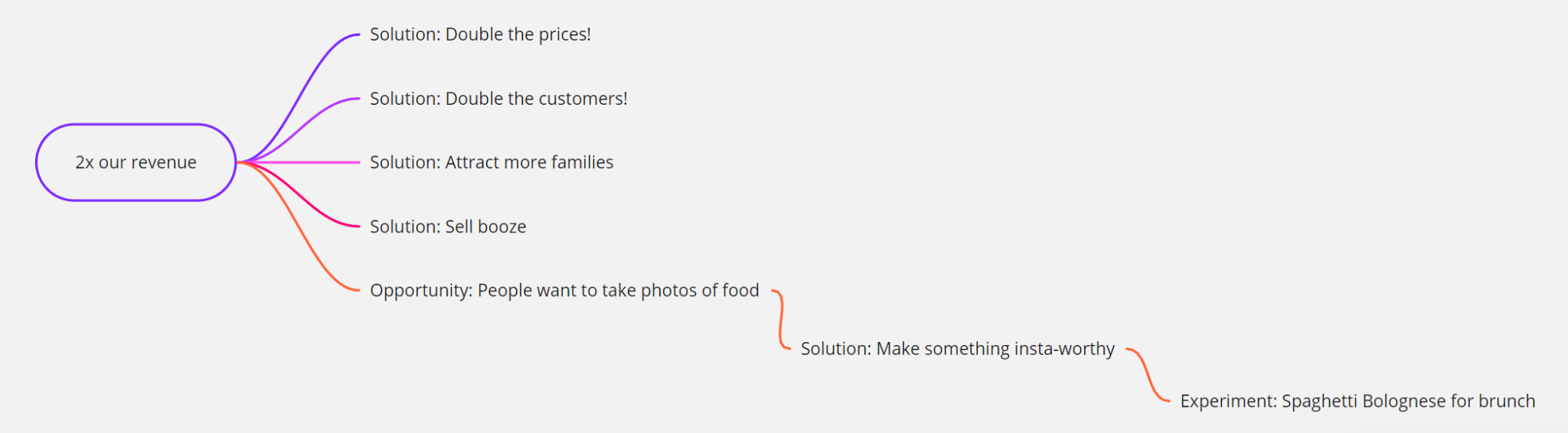
This is a different type of idea, because it attempts to address a user’s needs. It’s testable, so it is possible to iterate towards success. The other ideas are solutions. We try them once, and we get stuck if they don’t work.
A few years of building these trees has taught me that:
- We jump to solutions instinctively
- Opportunities and user needs exist in the world, we just have to notice them
- We can imagine many possible solutions to address an opportunity
- We can design an experiment to test if this is the right solution for the opportunity, and to see if the opportunity really exists.
I started making an opportunity solution tree for my work for money track. Starting with the goal of making enough money to survive.

Everything that looked like ‘get a job’ was a solution with no opportunities attached to it. I was trying to find ways to pinch money out of companies without having to actually work there. It took me a long time to realize that a job hunting mindset (please please hire me) is the wrong way to approach this.
So I had to dig deeper to find opportunities that I was uniquely positioned to take advantage of.
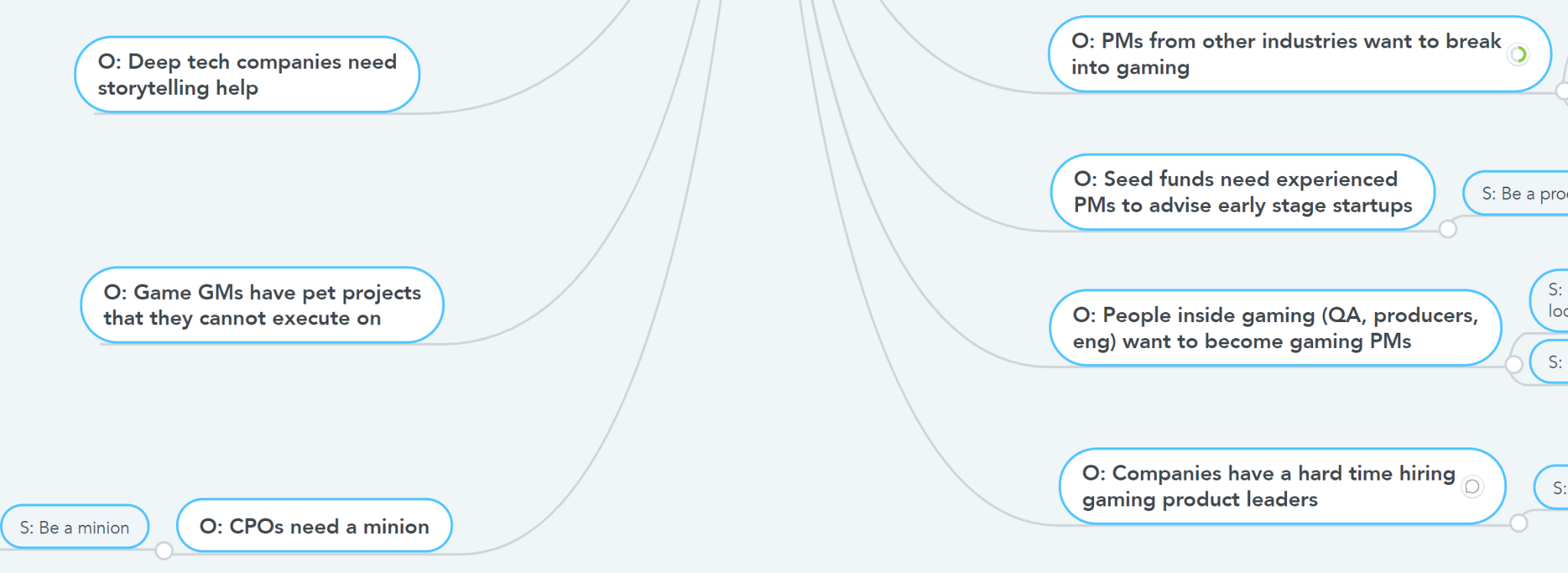
The opportunity that actually led to a gig was “CPOs need a minion”. CPOs are Chief Product Officers. I hounded all the CPOs I knew and asked if they needed a minion. One of them did, and that got me started. Phew!
It is important to say that this was my opportunity-solution tree, for my context. Your tree will look different, because you have different goals and you are good at things that I am not.
It’s true what they say: anything new is gonna be twice as hard and take twice as long as you think. Thankfully, I had banked 18 months of savings before quitting full time work in November 2019. In my case, it felt ten times harder and took four times longer. I thought I’d figure out the money-making in three months, but it took me more than a year. The pandemic didn’t help.
Tracking creativity
I had freed up time to write but I didn’t know how to make use of all this time that I had created for myself. There was no clear goal. I was anxious and worried a lot about the future. It was hard to focus. I was constantly stressed, and everyone — including me , was wondering why the hell I couldn’t get anything done.
A badly managed product team feels exactly the same. I know how to fix this! I spent 15 years as a product manager trying to avoid this catastrophe. I needed to think in terms of objectives. I needed OKRs — Objectives and Key Results.
If someone tells me they do OKRs for their personal life, I mock them to the moon and back. Silently, in my head of course. When I first did OKRs in October 2020 — for Q4, gawd, I shared it with a PM friend of mine and was promptly, and rightly, laughed at. I would have done the same.
If you already know how OKRs work, skip ahead. Don’t forget to laugh first.
We start with the objectives. They are strategic in nature and broad AF. For example: be the top video destination for kids.
Wow! How do we do that? We come up with KRs, Key Results, that we can measure ourselves by. The key thing, ahem, is that key results are not things to do. It is the results that we want to measure. We could say that launching a product is a key result. It’s done, woo! Party! Launching is a binary thing. Either we have done it, or haven’t. It’s pass/fail. Who’s administering this exam?
Or we could get a 1000 kids using the product. Building the thing is not enough. What we really want is for people to use the thing so that we can get feedback, and build a better thing. Wording a key result like this means that we have to find the 1000 kids. We can’t just build the product, we must also figure out growth.
This is not pass/fail. It’s okay if we only get to 500 kids. Or 800. Or 100. We are going in the right direction, we are not at zero. The only disagreement is about the speed of progress, not on whether we are making progress.
Writing a good KR is an art form. Especially in a team setting where everyone has different worldviews. And this is where a product manager comes in. They bring everyone together and tread that fine line of listening to everyone, getting it done, and not wasting people’s time in hours of ‘OKR sessions’. Come on, again? We have real work to do.
So I drafted some OKRs for my life, and was promptly laughed at. These are my OKRs from earlier this year.
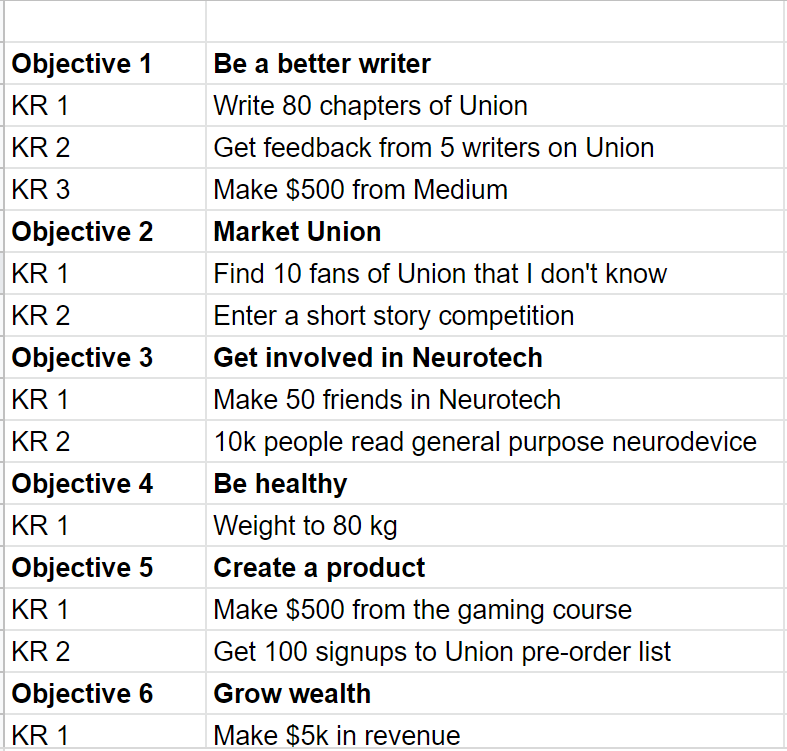
I don’t achieve most of my OKRs. These KRs were not supposed to be hittable, they were meant to push me in the right direction.
You are not a product
OKRs and opportunity solution trees are part of a product manager’s toolkit in tech companies. So this begs the question— why does a product manager approach help to structure a creative life? Is it simply because I was a product manager, so this is the only way I know how to do things? It’s certainly a part of it.
But am I a product?
We are not products, we are creative people. We are capable of making products— we are product producing machines. The difference is that if we are a product, we must figure out how to sell ourselves. Product producing machines make things, work out what to put out in the world and think of each product separately, with different goals.
After two years of going down this path, I now have four tracks. This is my ‘future of work’: multiple tracks.

In the time that it took to make this diagram, and publish this post… my work-for-money gig ended. A brutal reminder that this sort of structure is very, very precarious. Multiple tracks is not an end state, it is a constant work in progress.
We are product managers, because we must manage this product producing machine that is us. We have limited time, money and energy and yet we have this immutable drive to create new things. Bad product managers don’t set realistic expectations, have no plans and are constantly stressed. Good product managers are realistic, have a clear vision and are kind to themselves.
Wanting to work on creative projects and needing a steady paycheck at the same time is hard. Giving up a steady paycheck means there is constant worry and anxiety about what is going to come next. It is extremely destabilizing, especially if it becomes existential. Do you need to buy a house? Good luck with that.
This is the trap of uncertainty and it is hard to escape from it to pursue our dreams. So how to be creative in constant uncertainty? We figure out how to live with it. It doesn’t go away. It’s the price we pay for trying to live life as a creative person. If we don’t want to pay this price, or can’t pay this price, we get a job. Most of the time, our circumstances don’t even allow us to think about living a creative life. Every week, I almost give up and find a job.
When I stopped working full time to write more, I thought writing would be the hardest thing. No, the hardest thing was figuring out how to enable the writing.
We are all trying to enable ourselves. In the passion economy, we are all product managers. We get to manage our product producing machines, and the hardest thing is to choose our own objectives, independent of what the world thinks.
We get to choose our objectives. We get to choose the language to describe our lives, which gives us power over our narratives. If we don’t control our narrative, someone else will give us one.
————————
Get notified of new articles on WhatsApp. I’m not doing email because I don’t want to send any newsletters. I just want you to know when a new Fifteen Minute Read is out. Hopefully, you’ll like it and share it with your friends.
You insist on receiving emails?! Fine, subscribe here.
I want to do this in a fully private way using Signal, coming soon.
If I can help you use PM techniques for your creative life, just get in touch on WhatsApp.